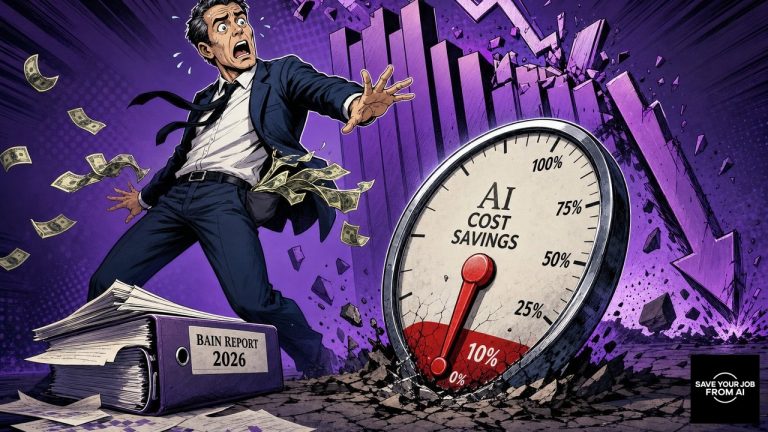

The entry-level jobs crisis is no longer a projection. A 16% drop in employment among 22-to-25-year-olds in AI-exposed fields. A 42.5% underemployment rate for recent graduates, the highest since COVID. The data is public, and it points to a structural shift that is not waiting for anyone to catch up.
Key Takeaways
- Workers aged 22-25 in AI-exposed jobs experienced a 16% relative decline in employment following generative AI’s spread, per Stanford Digital Economy Lab
- Recent college graduates faced 5.6% unemployment and 42.5% underemployment in Q4 2025 (record levels since the pandemic)
- AI is not eliminating senior roles: it is removing entry-level positions, blocking the first step on the career ladder
The Numbers Behind the Entry-Level Jobs Crisis
The Stanford Digital Economy Lab published its findings in November 2025. Workers between the ages of 22 and 25 in occupations heavily exposed to AI experienced a relative 16% decline in employment after generative AI became widespread. That figure does not describe laid-off senior employees. It describes young professionals who never got hired in the first place.
The Federal Reserve Bank of New York added another layer: recent college graduates faced a 5.6% unemployment rate in the fourth quarter of 2025. For context, that is higher than the overall national unemployment rate at the time. A degree, which used to be an entry ticket to the job market, is no longer guaranteeing even a first interview in the most AI-exposed fields.
The underemployment figure is even more telling: 42.5% of recent graduates are working in jobs that do not require a degree. That is the highest rate recorded since the COVID pandemic. Many of these workers are not unemployed. They are working, but in roles that pay less, build fewer transferable skills, and offer no path toward the career they trained for.
The job application numbers paint the sharpest picture. Recent graduates are routinely submitting hundreds of applications before receiving a single offer. What used to take weeks now takes months, and that is for the candidates who eventually land something. For many, the process ends with nothing.

Which Jobs Are Disappearing and Why
The fields taking the hardest hit are not random. Software development, customer service, computer programming, and information systems management are at the top of the list. These are exactly the roles where generative AI (AI systems that can write, code, and communicate) has been most effectively deployed over the past two years.
The logic is straightforward. Entry-level roles in these fields typically involve tasks that are well-defined, repetitive, and documented. Write this function. Respond to this ticket. Generate this report. These are precisely the tasks that AI tools handle most reliably. A junior developer’s first-year workload can now be partially automated by tools already built into the platforms those companies use.
Senior roles are largely untouched. Managing ambiguous projects, building client relationships, making judgment calls under pressure. These require experience that AI does not replicate well yet. Companies are holding onto their experienced staff and using AI to reduce headcount at the entry level, not at the top.
The deeper problem is structural. Entry-level positions have always been how professionals build the experience that makes them valuable at higher levels. If the first rung of the career ladder disappears, there is no path to the middle rungs. That is not a problem for today’s workforce alone. It is a problem for what the workforce looks like in ten years.
Also on Save Your Job:
What You Need to Do Now
This crisis is not a future scenario being discussed in policy papers. It is already happening to people graduating right now, sending out hundreds of applications, and hearing silence. If you are in an AI-exposed field or know someone who is, the window for a strategic response is narrow and getting narrower.
The researchers behind this data point to concrete responses. Universities are being urged to embed AI literacy and verification skills into degree programs before students graduate. Governments are being pushed to introduce tax credits and wage subsidies for companies that maintain entry-level hiring. Companies themselves are being asked to view junior hiring as a long-term investment in workforce capability, not just a cost line to cut.
But those are systemic changes that take years. If you are a working professional in an AI-exposed field today, waiting for policy to catch up is not a strategy. The professionals who are staying relevant right now are the ones who understand which parts of their work AI can replicate and which parts it still cannot. They are actively building skills in the latter category.
The data shows that overall employment remains stable for now. Senior roles are safe for now. But “for now” is doing a lot of work in that sentence. The 16% drop among the youngest workers in AI-exposed fields is not a blip. It is the leading indicator of what happens next to everyone else on that career ladder as AI tools continue to improve. Start building your AI-proof skill set before you need it: the right tools to get started are here.
Follow the story on Save Your Job.
About the Author