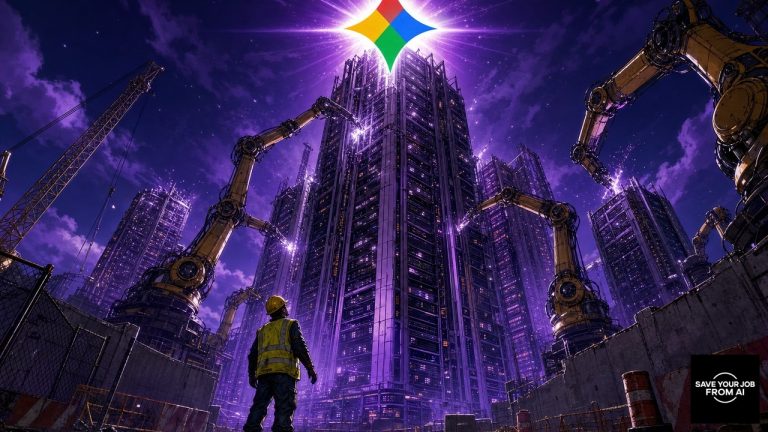

Google AI agents are now running inside Search around the clock, researching and reasoning across the web without you asking. If your job involves finding information, monitoring topics, or producing analysis, these agents just took a direct shot at your daily workflow.
Key Takeaways
- Google’s new Search agents run 24/7 in the background, reasoning across the web on your behalf.
- The technology is powered by Gemini 3.5 Flash, now the default AI engine in Google Search globally.
- Knowledge workers in research, analysis, and monitoring roles are the first to feel the impact.
What Google Just Launched at I/O 2026
At its annual developer conference, Google announced a fundamental shift in how Search works. You can now create, customize, and manage multiple AI agents directly inside Google Search. These are not chatbot assistants you talk to. They are autonomous programs that run in the background, continuously reasoning across the web, and report back to you.
Google calls the first type “information agents.” You set them up to track a topic: a competitor, a market, a technology, a news beat. They then monitor the web around the clock, pulling relevant content and synthesizing it for you automatically. No manual searches. No scheduled alerts. The agent just works while you’re doing other things.
The engine behind all of this is Gemini 3.5 Flash, which launched simultaneously as the new default AI model powering Google Search’s AI Mode globally. It’s faster, more accurate on complex reasoning tasks, and significantly improved at understanding nuanced, multi-step queries. This isn’t a feature update. It’s a new layer of infrastructure built on top of the world’s most used search engine.
Google described this transition as entering “the era of Search agents.” The language is deliberate. The company is explicitly positioning AI agents as the replacement for active, manual search behavior. The kind that currently requires a human to initiate, read, evaluate, and summarize results.
The rollout started this week with the information agent type. Google has announced additional agent categories are coming, covering tasks beyond monitoring and research. The platform is being built out progressively, with more capabilities expected through the second half of 2026.

The Work These Agents Are Doing: Work That Pays Your Salary
Let’s be specific about what “researching and reasoning across the web” means in a professional context. It means competitive intelligence. Market monitoring. Industry news aggregation. Early signal detection. Trend summarization. These are not abstract tasks. They describe the core of what research analysts, communications professionals, marketing managers, and intelligence teams do every day.
A junior analyst who spends three hours each morning building a briefing from news sources is now doing work that a Google AI agent can replicate in minutes, automatically, before anyone arrives at the office. The agent doesn’t call in sick. It doesn’t take vacations. It doesn’t miss a story because it was in a meeting. It just runs.
This is the pattern the AI job market data has been pointing to: entry-level and task-based roles are the first to absorb the impact of automation. The information agent is textbook AI job displacement: a discrete, well-defined, repeatable task that requires broad web access and synthesis skills, now handled by software.
More experienced workers are not immune. If part of your value proposition to an employer is “I stay on top of what’s happening in X,” that specific value is now commoditized. The competitive moat around staying informed has largely disappeared. What remains is judgment: what to do with the information, which signals matter, and how to act on them.
And judgment, for now, is still a human job. The question is whether you have built enough of it to remain the person making the calls, rather than the person who used to gather the data.
Also on Save Your Job:
- Impulse Space Raises $500M to Hire Humans, Not AI
- AI Job Market: The Real Numbers Behind the Panic
- Devin Writes 89% of Its Own Company’s Code. You’re Next.
What You Need to Do Before the Agent Replaces You
The instinct when you read news like this is to dismiss it. “My job is more complex than browsing the web.” That may be true. But the entry point for AI displacement has never been the most complex version of your role. It starts with the parts of your job that look like information retrieval, and it moves up from there.
The professionals who are not at risk are the ones whose output depends on relationships, institutional trust, accountability, and creative interpretation. If you are regularly asked to make judgment calls that carry real consequences (decisions your employer wouldn’t want an AI to make alone), you are in a stronger position than someone whose daily output is a research briefing.
The practical move is to shift your visible value from information gathering to interpretation and action. Document what you do with the research, not just that you did the research. Position yourself as the person who transforms signals into decisions, not the one who collects the signals. This is a subtle but significant difference. It’s the same gap that already separates the workers thriving in the AI era from those being displaced.
The second move is to learn to direct these agents rather than compete with them. A professional who can configure Google AI agents, validate their outputs, and act on them faster than a colleague who hasn’t adapted yet has a real advantage. The gap between those who use AI agents and those who don’t is going to widen fast over the next six months.
The tools to make that shift are available now. The window to do it on your own terms, before a performance review or a restructuring forces it, is still open. Start at [URL_FORMATION] and build the skills that sit above what an agent can automate.
Follow the story on Save Your Job.
About the Author